Introduction
Indian mulberry is an evergreen shrub or a small tree growing up to 5-10 m tall. The plant is extensively cultivated in India to make the morinda dye sold under the trade name ‘suranji’. The fruit is widely used in eating challenges in British reality television programmes. Where it is referred to as ‘vomiting fruit’. It can be found in various environments, including volcanic terrains and cleaning or limestone outcrops as well as coral atolls. The plant has been extensively cultivated in India for the dye obtained from the root bark. It is a popular medicinal plant in Thailand, where it is often gathered from the wild and is also a local source of timber. The plant contains anthraquinone, which can be harmful to human health. Although the fresh fruit is edible, its pungent odour makes it worthwhile only as famine food. It is also used in traditional medicine and processed into products such as juice. The plant flowers and fruits all year round. It can be cultivated and found naturally across tropical and subtropical regions of the world. The morinda, better known as noni fruit, has a bitter taste and unpleasant smell but several healing properties.
Native
The plant is native to South and Southeast Asia, ranging from Sri Lanka and India to Java.
Common name
There are 100 names for this fruit across different regions, including Indian mulberry, Morinda, Aal, Aseti, Dhaula, Mannaunai, Mannnanati, Molagu, Achu, Pindra, Togar Mughalai, Paphnah, and Brimstone tree.
Tree Height
It can grow up to 9 metres tall.
Stem
The stem is short and crooked, with rough bark with deep longitudinal cuts.
Leaves
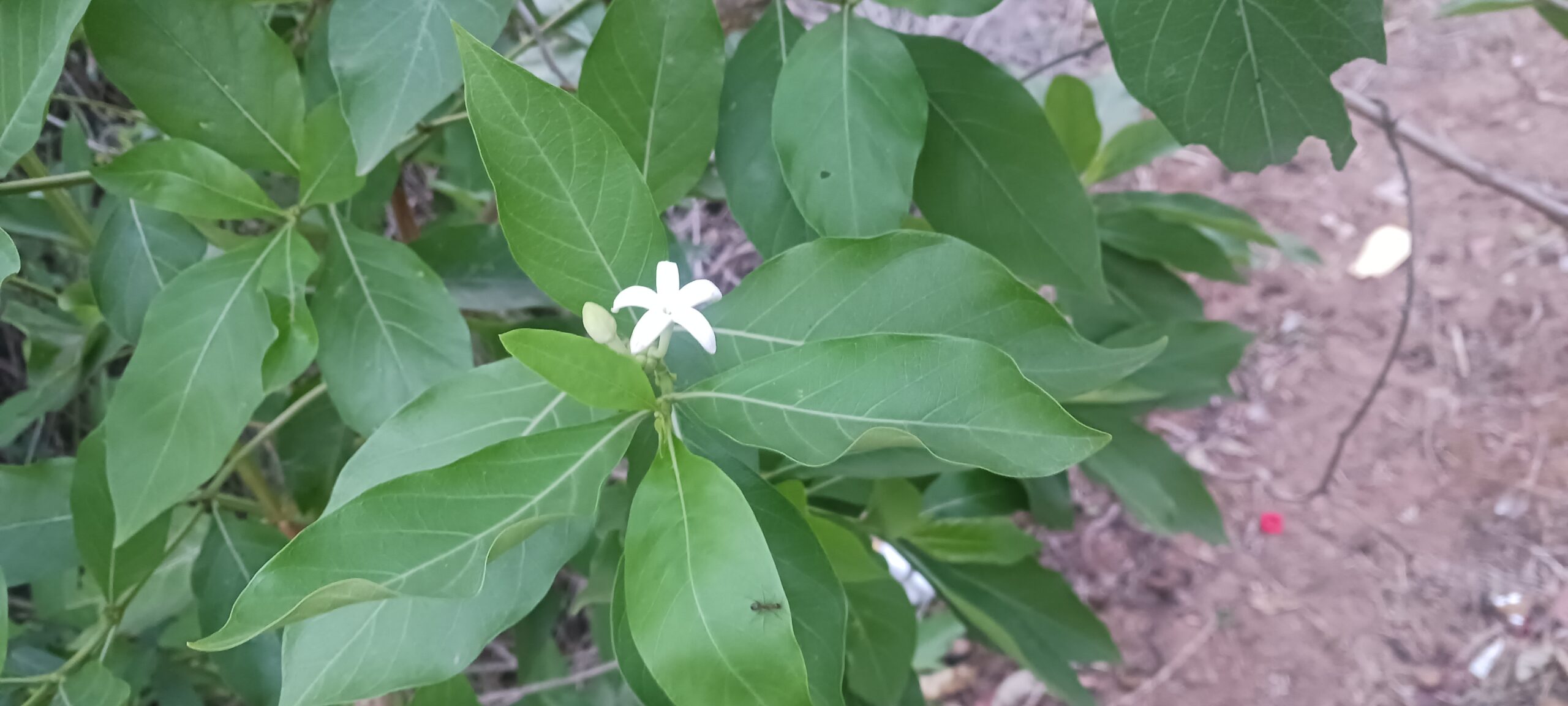
The large glamorous leaves are arranged in opposite pairs on twigs reaching up to 25 cm long and 13 cm wide. They are elliptic to ovate in shape and have 6-9 pairs of lateral veins. It has large, simple, dark green, shiny, and deeply veined leaves.
Flower
The flower occurs in spherical heads, 3-5 cm across, on a stalk 2-3 cm long. Near the stalk of the flower head there is a small linear leaf. The flower is tubular and white, scented and about 2 cm long. Oblong petals are about 1 cm long and 3-7 in number. stamens as many petals. The inflorescence is a dense head of flowers produced at the apex of the branches. There may be up to 90-100 flowers in the head, but only a few open at the time. The flowers are white and tubular, with five lobes measuring about 1.5 cm long and across. It flowers from spring to early summer, which corresponds to the months of March to June. However, variation may occur due to local climate conditions and other factors.
Fruit
The fruit is a green syncarp 2-2.5cm in diameter. They are initially green, transitioning through pale yellow to white or grey. When ripe, emit a pungent odour like blue cheese. They are irregularly ellipsoid or ovoid and may reach up to 9 cm x 6 cm.
Seed
The fruit is a multiple fruit consisting of fused drupes, each containing four seeds.
Habitat
It is now cultivated throughout the tropics and is widely naturalised. Apart from the saline condition, the plant can withstand drought and grow in secondary soils.
Soil preference
It tolerates saline soils, drought conditions and open rocky or sandy shores. It can be found in various environments, including volcanic terrains and clearings or limestone outcrops as well as in coral atolls.
Watering
In its natural habitat, noni thrives with moderate watering and can survive extended periods of drought once established and mature. Regular watering 2-3 times a week is required during establishment. Later, water only during long periods of drought or in hot, dry weather.
Sun requirements
Morinda can grow in a range of light levels from full sun to shade. Tropical leaves become big and dark in the shade. Low light reduces the number of flowers and fruits.
Planting
Once the plant reaches a certain height, plant it in the main field with a pitting size of 1.5 m x 1.5 m x 1.5 m and a spacing of 2 m x 2 m.
Pruning
This tree can grow quite large, necessitating regular pruning of its branches to maintain a desirable shape. Dead, diseased branches should be removed to improve air circulation and penetration of sunlight.
Propagation
Morinda can be propagated by seed and stem cuttings. It is grown in rich, moist, well-drained soil in full sun to part shade. Tolerate full shade but with decreased flowering and fruiting. Established plants tolerate some drought. Take seeds from the fruit and soak them in water. Rub to remove the pulp; once clean, sow on a bed of seed-raising mix and cover lightly. Place it over a heat mat and water regularly. When plants have developed their first few leaves, seedlings can be potted and moved to a protected area in partial shade. Once it starts maturing, move it to a position with full sun.
Nursery
Sow in nursery beds. Germination takes place 3-9 weeks after sowing. After germination, seedlings are transplanted. The seeds remain viable for at least 6 months.
General uses
It has long had a reputation for its healing qualities. Most parts of noni have been widely used medicinally since ancient times. The fruit has traditionally been used by Austronesian people mainly for producing dyes. Morindone is used for the dyeing of cotton, silk and wool in shades of red, chocolate or purple. The colouring matter is found principally in the root bark and is collected where the plant reaches three to four years of age. Moorinda bark produces a brownish-purplish dye that may be used for making batik. In Hawaii yellowish dye is extracted from its root to dye clothes.
Diseases and pests
Common pests include scale insects, mealybugs, and aphids. Fungal diseases may occur in poorly drained soils or highly humid conditions.
Chemical Constituents
The plant contains compounds such as morindone, anthraquinones, flavonoids, alkaloids, glycosides, and other bioactive substances.
Classification
- Kingdom: Plantae
- Phylum: Tracheophyta
- Class: Angiosperms
- Family: Rubiaceae
- Genus: Morinda
- Species: Morinda coreia
Frequently Asked Questions (FAQ)
1. Is morinda edible?
Morinda fruits are edible but have a strong flavour and unpleasant smell when ripe. At first it is green and eventually turns yellow and almost white as it ripens.
2.Why is the fruit called starvation fruit?
Indigenous peoples used the fruit as emergency food during times of famine. Despite its strong smell and bitter taste, the fruit was eaten when other food sources were unavailable.
3.Are the seeds edible?
Yes. The seeds are edible when roasted.
4.How is the fruit consumed?
In Southeast Asia and among Aboriginal Australians, the fresh fruit is eaten with salt or cooked in curry preparations.
5.Does the plant flower and fruit throughout the year?
Yes. The plant flowers and fruits throughout the year. It is common to see flowers and fruits at different stages of development on the same plant.